

Computing Catalyst: Cracking Nature’s Smallest Mysteries
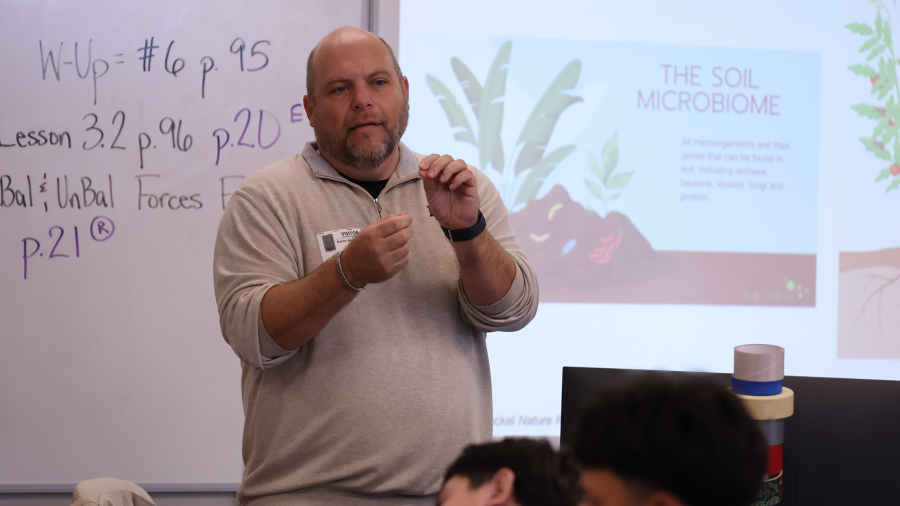
What is the difference in complexity between the human genome and the genome of an individual microbiome bacterium? Answer: The human genome is comprised of about 15,000 more genes than that of a single bacterium. This difference may seem large, but when realizing that it would only take about four individual bacterial species in the gut to have an equivalent amount of genes as a human genome, then that is significant! Now, extrapolate that bacteria quantity into the trillions because the human gut contains, on average, 10 to 100 trillion individual microorganisms made up of 100s of species. Understanding the makeup of these bacteria is an extraordinarily difficult task, but it is one that Dr. Aaron Wright at Baylor University is tackling head-on.
Dr. Wright, an esteemed professor in the Department of Biology and head of the Wright Group, realized early in his career that there was, as he puts it, “a really unique and discrete opportunity that other people weren’t pursuing in the microbiome.” This opportunity, stemming from his time as a postdoc using chemistry to understand protein function, focused on doing protein analyses of microbiome bacteria.
“There’s not very many people working on this because of the complexities,” Dr. Wright mentioned, “The pipelines you have to build, the infrastructure you need to have, the things you have to do.” By utilizing gene inference, Dr. Wright and his team can work to predict what an individual bacterium will be in its microbiome. This allows them to figure out if there is the potential for diseases that may affect individuals, such as ulcerative colitis.
If you asked Dr. Wright years ago why his interest lies within this space, he would tell you, “My interest is much more driven by ‘can we understand protein function as it associates to, say, diseases like inflammatory bowel disease, ulcerative colitis?’” Now, however, he would add, “I just have a keen interest also in ‘how do we do this the best that we can possibly do it?’ Before, I think it was ‘how could we do it?’ Now, I think we’re able to ask, ‘how can we maximize the efficiency?’” The Wright group, now more experienced in both scientific and technological aspects of the research, can focus on trying to “get the very, very best data out of it (the research).”
Working towards maximum research efficiency is not a task that one can face alone. Dr. Wright relies on members of the Wright group to help with this journey. This group, comprised of postdoctoral fellows and students (both graduate and undergraduate), works diligently to maximize efficiency and reliability with all projects conducted in this space. One particular postdoc, Dr. Tulasi Relangi, has employed his computational skills to aid in this strive for efficiency. At the moment, the Wright group has dealt with the challenges that naturally come with data collection and analysis. “We’re throwing out so much data,” Wright detailed. Relangi added, “We are losing 70 to 80 percent (of the) data.” When working with so many different organisms, “you could have three things that are very, very similar and it (computing tools) can’t decipher one,” Wright expressed.
Relangi has worked to create a machine learning algorithm to aid with understanding the data that is being gathered within their experiments. This machine learning algorithm has enabled the group to pull about 20% more usable data out of the bin than was previously able. By working to solve this problem, Relangi and other team members help support Dr. Wright and others in similar research spaces, as they plan on releasing the machine learning algorithm in the future. The Wright group utilizes Kodiak, Baylor's High Performance Computing (HPC) research environment, to support these computing needs. “That’s probably the most exciting thing that’s related to Kodiak,” Wright added in regard to Relangi’s machine learning algorithm. Relangi and team are very thankful that Kodiak has allowed them to facilitate their research projects. “We are happy that when I came here, and we had this HPC, it’s really very helpful,” Relangi continued, “In some other universities, they may not have these computational facilities.”
While a few members of the team do have experience working with computational work, “almost all of my other students from chemistry and biology don’t have that kind of background,” as Dr. Wright explained. Relangi has supported the group by developing a GUI (graphical user interface) system that allows students and other group members who aren’t computationally savvy to assist in running experiments. Dr. Wright exclaimed, “We basically rebuilt what exists at the National Lab (Pacific Northwest National Laboratory) at a scale for this lab and made it so that grad students that aren’t computationally savvy, those who are more like myself, can also interface with the system.”
One challenge being faced by the Wright group is that their field of study is more niche, meaning most software is not specifically dedicated to their type of research. “The most common software is called MaxQuant, but it’s not for microbiome,” Dr. Wright explained. Relangi continued, “To do the microbiome stuff, it’s just a whole other animal.” This challenge does not relate specifically to MaxQuant, but to all software the group utilizes for working with the microbiome. “MS-GF+ (another software platform used by the group) is not optimized for microbiome,” Relangi stated. “I’ll read all the documentation, and then we can figure out how to work with microbiome.” The Wright group explores these different software tools deeply to best understand them and then enable them specifically for microbiome research.
Every individual is different, and this fact applies to every individual’s microbiome. “Everybody’s microbiome is different,” Wright stated, “but there are a number of functions that it performs in all of us.” While microbiome differences can stem from many different sources, “you still expect the functions to be very similar.” Wright exclaimed, “Endlessly running the amount of data we run is not actually going to be a solution to understanding those things.” His goal is to truly understand the different important activities that proteins in the microbiome are performing.
By working to understand the functionality of microbiome proteins, they can perform work such as understanding if a person will respond poorly to a drug due to having a specific protein complement in their microbiome. “It is computationally intensive to get to the point where we can actually develop the predictive frameworks to be able to do that,” Wright explained. Still, working towards this goal of valuable predictive frameworks is a long-term vision that Dr. Wright strives towards.
Dr. Wright and his group are another shining example of Baylor University’s commitment to research. Research projects such as these highlight Baylor’s unique status as an R1 university that also encourages the integration of Christian faith with intellectual life. Fact and faith strengthen one another, and Baylor University uses this strategic advantage to impact the world in a positive way. The use of existing technical resources at Baylor University, such as the Kodiak High-Performance Computing cluster, allows researchers like Dr. Wright to make the world a better place for all.
For more stories highlighting Baylor University researchers, as well as information pertinent to research technology at Baylor University, visit the BaylorITS Research Technology team website.