

Computing Catalyst: Computing the Universe—How Baylor and CERN Turn Data into Discovery
Understanding the secrets of the universe is not only a scientific ambition; it is a computational challenge that is measured in petabytes, millions of detector channels, and decades-long research timelines. The Baylor Experimental High Energy Physics (HEP) group, in partnership with CERN (The European Organization for Nuclear Research), works to help answer this seemingly answerless question: How can one truly understand the secrets of the Universe?
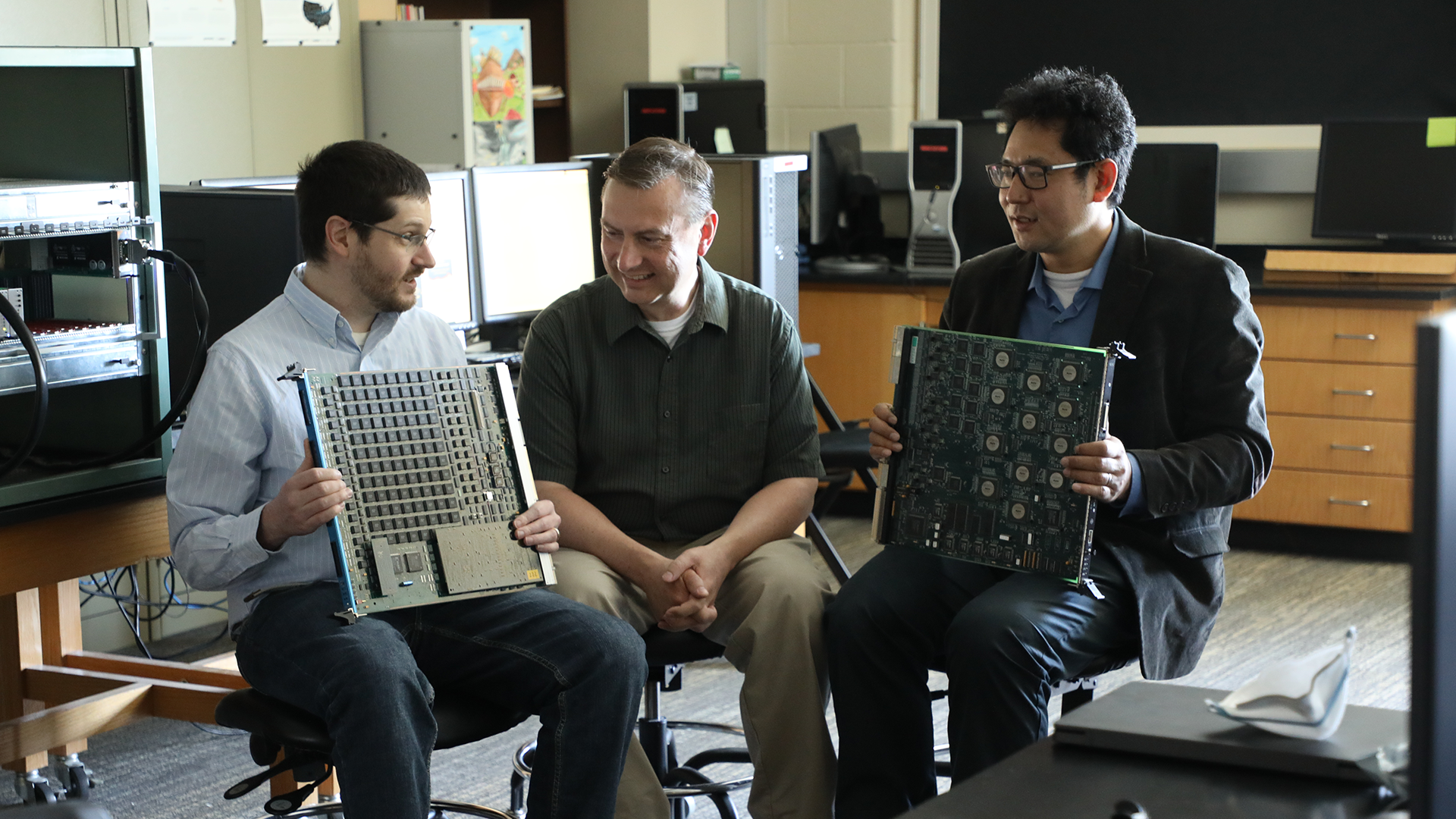
Professors Andrew Brinkerhoff, Jay R. Dittmann, Kenichi Hatakeyama, and Jonathan Wilson, along with their postdoctoral and graduate students, work with global collaborators to enhance humanity’s understanding of how the universe and matter truly function.
Dittmann started at Baylor in 2003, and, as he recalls, “it was really when Ken (Hatakeyama) joined us in 2009 that we were able to get involved full-time on the CMS experiment at CERN.” Baylor has been a member university since 2010, and Hatakeyama brought expertise from his previous work that helped us advance our involvement in the Hadron Calorimeter (HCAL) Project. The HCAL project is part of the Compact Muon Solenoid (CMS) experiment at CERN.
Brinkerhoff joined the team in 2019, and Wilson joined in 2025. Each member brings a different type of expertise that allows the group to expand and tackle various aspects of particle physics. As Dittmann explains, “It was almost more than ‘1+1’ or ‘2+1=3’ because in our collaboration, people work so closely together that it really almost just multiplies because you have additional people.”
To approach such complex questions, the HEP group focuses on specialized areas of physics. “We’re studying particle physics,” Wilson explained, “in particular, within our group, we're studying the physics of the top quark and the Higgs boson. And, also, looking for signs of new particles or new interactions that have not yet been discovered in a variety of ways.” Dittmann added, “Collectively, we have been working not only on the existing detector and the collection of data and the analysis of data, but we’re also always forward-thinking to the different types of upgrades that can be done.”
Hatakeyama considers the three pillars of work within the HEP group to be the Higgs boson particle, dark matter, and dark energy. One aspect of research examines the Higgs boson particle and its reactions with other standard model particles, while another focuses on how the Higgs boson particle decays. These areas lead to different questions that all seek answers and are being worked on, thanks to the HEP group.
Regarding dark matter, the group is not focused on its existence, but rather the identity of the matter. Hatakeyama explained, “If the LHC is energetic enough, we should be able to produce those dark matter particles directly and try to find hints [about its identity] with its collisions [with other particles].”
The Baylor HEP group’s developments in instrumentation have made important contributions to the field. The CMS experiment detector is made up of “several different subcomponents,” according to Hatakeyama. Baylor researchers work on the part of the detector known as the Hadron Calorimeter, which measures the energy of the particle species called hadrons. Dittmann has been one of the leaders of the Hadron Calorimeter, and without Baylor’s contribution to this instrument, Hatakeyama notes, researchers could not do anything with the project.
Wilson, in particular, has been working with Hatakeyama on long-term research that “will become a major part of the legacy of the LHC (Large Hadron Collider) for decades to come.” This research revolves around a framework called Effective Field Theory (EFT). “Effective field theory is going to be a very, very nice way to summarize the impact of the entire collection of the Large Hadron Collider data,” Wilson described, “So I’m working on EFT-related analyses now, but always looking towards laying the groundwork for establishing that eventual legacy.” The area of particle physics that the HEP group focuses on differs from many areas of physics due to the long time scales involved. Dittmann explained, “Most physicists just do not use sentences in which they say, ‘In 2040, this is going to happen.’ We have a field where the equipment is so complicated and massive and intricate that it just takes a lot of coordination over a lot of time.”
With such a large amount of data that requires processing and analysis, Hatakeyama uses Baylor’s Kodiak High Performance Computing (HPC) environment. Data taken at CERN is distributed worldwide to partner institutions and groups through the Worldwide LHC Computing Grid (WLCG). According to Hatakeyama, Kodiak has been part of this since very early on. “In the U.S., there is something called the Open Science Grid (OSG). Through the OSG, Kodiak can communicate with the WLCG so that if we want this data for a specific analysis, then just by issuing certain commands on the web interface, we can pull the necessary data [from CERN or other remote sites].” Kodiak has enabled the HEP group to perform data analysis more efficiently at Baylor.
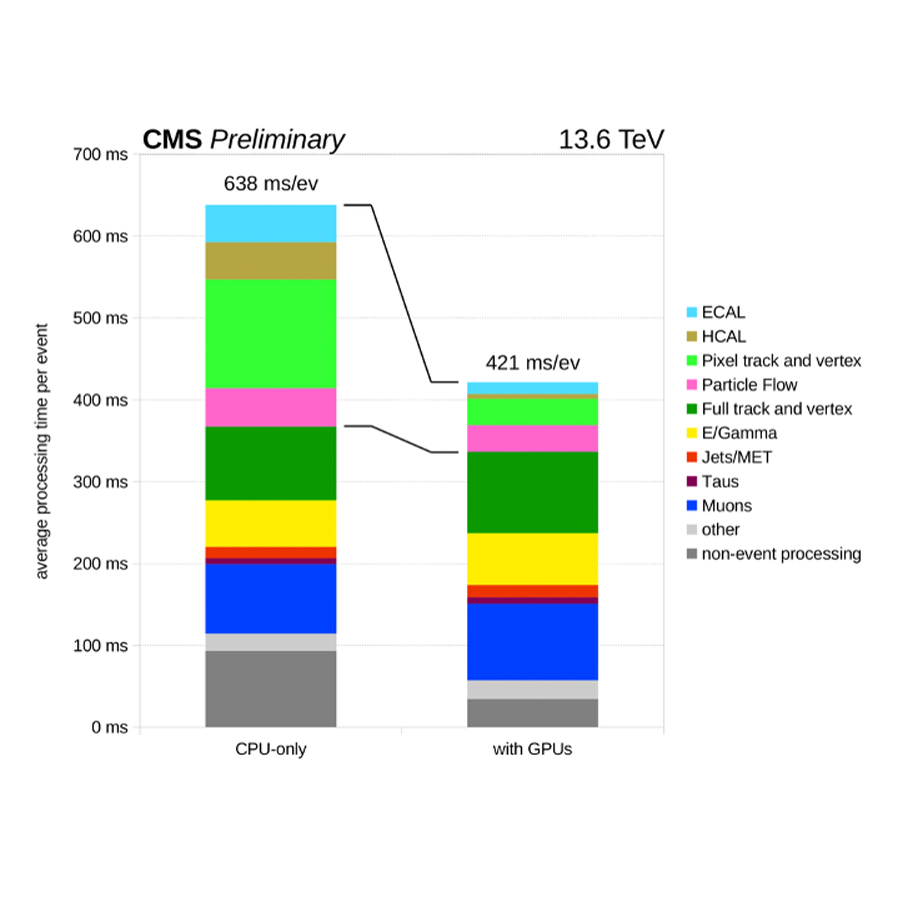
In addition to the Central Processing Unit (CPU) computing, HEP utilizes the power of Graphics Processing Unit (GPU) technology to handle heavy data processing. Hatakeyama has used the condominium model within the HPC environment to develop a new software that utilizes GPUs. They have a need for software that runs faster, and the condominium node is equipped to handle the large amount of computing power needed to process data. This project resulted in a reduced data processing time at CERN, as shown in the accompanying figure. Going forward, collision rates will substantially increase and demand additional software improvements. Hatakeyama’s focus on improving computing power and software is only made possible through the use of GPU processing.
The HEP group also has shorter-term goals aimed at helping students with their theses. “We always need theses for our students,” Wilson exclaimed, “So you always have to look for projects that take that 3-5 year time frame to complete so that some student can come in and do that project and write their dissertation and graduate. The work on these projects will move towards those long-term goals.” However, the benefit to students is not limited to creating theses. Wilson elaborated, “We’re always trying to make sure that we are providing our students with training that will serve them well, whether they stay in the field of particle physics or if they leave and go to industry.” He went on to add that, “The resources at Kodiak are a big part of us being able to provide the training to students that makes them attractive for well-paying jobs when they graduate.”
As Baylor moves into its next era of discovery, marked by unprecedented volumes of data and increasingly ambitious scientific goals, computing resources have become as essential to the process as the experiments themselves. Through the work of Baylor’s Experimental High Energy Physics group, high-performance computing transforms streams of particle collisions into insights that deepen our understanding of the universe. By combining global collaboration, cutting-edge instrumentation, and powerful computing resources such as Kodiak, Baylor researchers and students are helping shape the future of particle physics.