

The Chemistry of Possibility: Where Experiment, Theory, Modeling, and Computing Converge
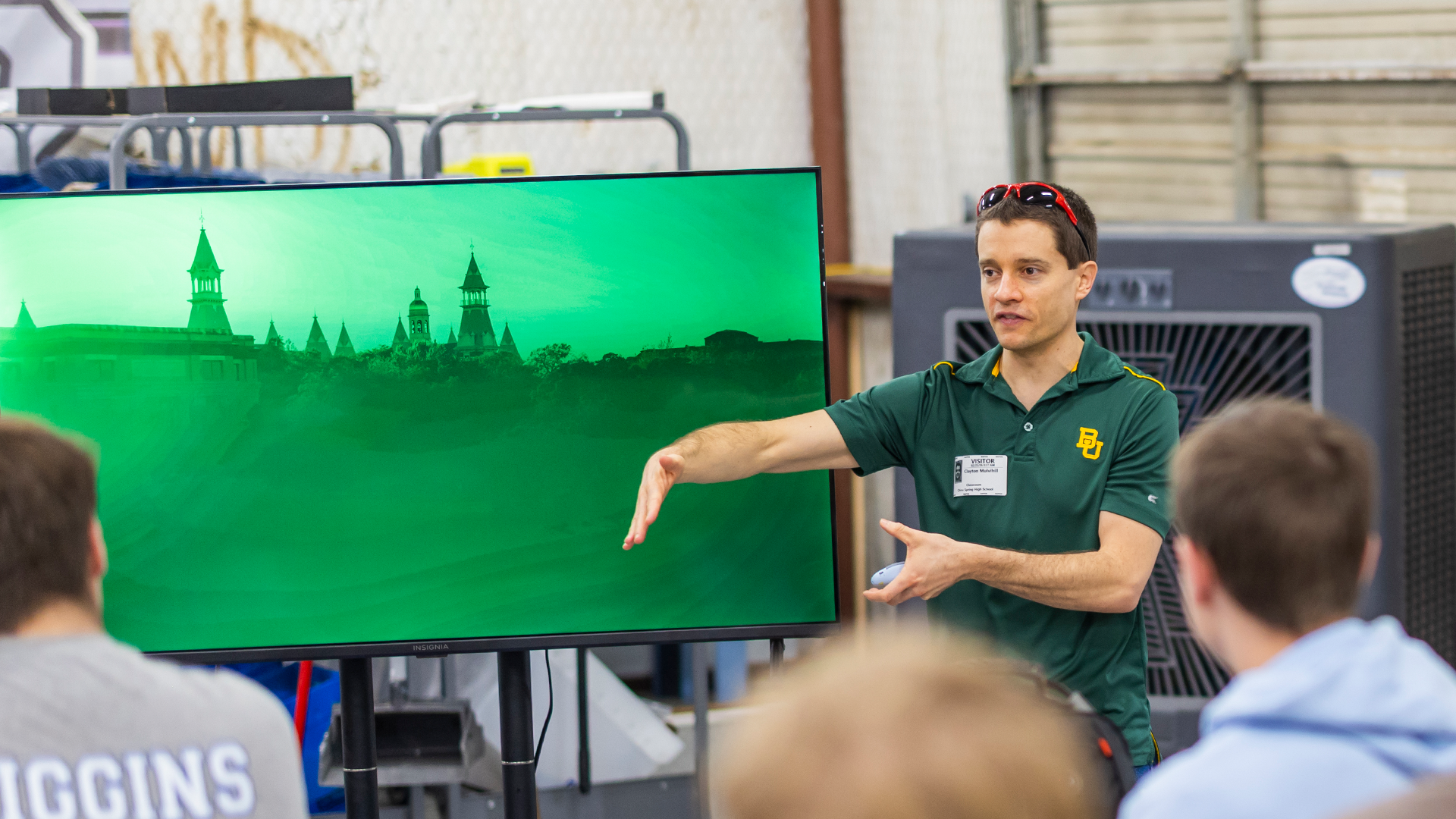
Can light change the way ammonia reacts? To answer this question, combine Experiment, Theory, and Modeling. The result? You achieve breakthrough research conducted by the Reaction Kinetics Lab at Baylor University, led by Dr. Clayton Mulvihill. Under the leadership of Dr. Mulvihill, his team relies on synergies between Experiment, Theory, and Modeling to unravel complex questions in the field of chemical kinetics. In layman’s terms: “We try to understand how gas phase reactions happen. We try to understand that through a combination of experimental and theoretical tools,” stated Mulvihill.
When asked about the cooperative relationship of Experiment, Theory, and Modeling in research, Mulvihill explained, “There are different niche areas that might be better suited to answer with an experiment, or with some kind of theory or modeling.” He continued, “The best kind of projects are those where we can synergistically combine all three.” Mulvihill went on to say that “[t]here’s something really beautiful about a well-run, clean experiment that produces really nice data. Then the types of visualizations that you can get from theory on the molecular scale and the types of beautiful pictures you can get of molecular level interactions—that’s really pleasing.”
Harnessing Light for Future Energy
The Mulvihill Group actively conducts hands-on experiments in their lab, utilizing a variety of tools such as a shock tube (a scientific instrument used to create shock waves) and lasers to gather data. From there, they employ computing resources such as Kodiak, Baylor’s High-Performance Computing platform, to calculate chemical reactions that are gathered in the lab. With this work, they are aiming to answer major scientific questions in the field of energy. As Mulvihill suggests, “One question we’re looking at is if we can influence the reactivity of ammonia by using ultraviolet light. Can we somehow influence how well the ammonia reacts?” The group sees the implications of this answer as potentially using ultraviolet light to better utilize ammonia as a future energy source. You read that right: ammonia as a future energy source.
“We’re trying to help develop cleaner and more efficient devices for better energy conversion of all different types and sorts,” Mulvihill said. The group continues to explore applications of gas phase chemistry in the production process for semiconductor chips, plastics, and different types of coatings. They work across multiple scientific disciplines, from chemistry to physics, to capture the information that they are looking for: “In the laboratory, we are looking at the chemistry,” Mulvihill explained. “We do that using absorption spectroscopy, which is where you look at how light is absorbed by something—in this case, gases.” Mulvihill and his team take findings from one study and apply them to other studies, such as ones where they utilize shock tubes and laser physics. Mulvihill expressed, “There’s kind of a nice combination.”
Scaling Discovery Using Kodiak
Working across multiple studies that gather unique data can be a daunting task, but Mulvihill utilizes High-Performance Computing resources to aid with the theory side of the methods that he uses. “What we’re doing is computationally estimating solutions to the electronic Schrödinger wave equation (a form of the quantum-mechanical Schrödinger equation that solves for the energy and wave behavior of electrons while treating atomic nuclei as fixed positions in space). Those interactions are quite expensive computationally to evaluate,” explained Mulvihill. “It’s possible to do such evaluations on personal workstations; but the scale at which you can do it would make it very difficult.” Mulvihill’s team leverages the Kodiak condo node program. In Baylor’s Kodiak environment, “the scale that we’re afforded is really what we need to be able to explore these interactions and modules.” Mulvihill added, “HPC resources allow us to multitask really nicely where instead of taking up our entire workstation trying one idea, we can try out five ideas at a time because there’s sufficient resources to do that.”
The Mulvihill Group makes use of multiple systems and software on Kodiak to work on whatever is needed at the time. When asked about this software and which is prominent in the research, Mulvihill informed us that “the program we call the most often is called MOLPRO, which is quantum chemistry software that estimates solutions to the electronic Schrödinger equation. That’s the one we’ve used by far the most, and we have a group-wide license.” He added, “We also will use Gaussian, which is a similar code. That one we have a university-wide license for, which is nice. Both of those ultimately allow us to explore those interaction energies between any kind of atomic configuration that we want to come up with and look at.”
Empowering Student Researchers
Mulvihill could not perform his research without the help of his students, especially when it comes to computational work with High-Performance Computing. He explained, “99% of the jobs are being run by, and are submitted by, the students. They are troubleshot by the students, and they’re interpreted by the students. They’re the ones who are SSH’d into the nodes, submitting jobs, watching the queue, checking for completion.” Mulvihill focuses on looking at results and helping students understand when things may not be going well. “They probably manage most of it on their own, I’d say.”
Investing in Long-Term Impact
The drive to discover cleaner and more efficient energy devices never ends. There is always more that can be done. Long-term strategy has never been more important, a fact that is not lost on Mulvihill. While discussing the importance of research infrastructure, he stated, “It feels like it’s very much playing the long game.” Baylor understands this, which is something that is not lost on Mulvihill. “The investments, like the building we’re sitting in right now (the BRIC), it’s a huge investment, and it’s great. It’s one of the big things that drew me here to Baylor, and I’m certain that it’s one of the things that’s drawing other new and future faculty members to Baylor.” He went on to say, “It’s more of a mid-term to long-term game that you play, but the payoffs for Baylor specifically have already been there. I’ve benefited from them, and I wouldn’t be here if it weren’t for the investors.”
Experiment tells researchers what happens. Theory helps explain why. Modeling allows them to ask what might happen next. Computing makes it possible to explore those possibilities at a scale that individual workstations cannot. But the ability to ask bigger questions and answer them depends on having the infrastructure to do so. For researchers like Mulvihill, high-performance computing is not simply a faster way to perform calculations; it expands the boundaries of what can realistically be discovered. It allows students and faculty to pursue multiple ideas simultaneously, explore molecular interactions at greater scale, and transform experimental observations into new scientific understanding. To get started on your journey of discovery through computing, contact research_technology@baylor.edu.