

Computing Catalyst: A High-Performance Quest to Transform Cancer Imaging

Dr. Keith Schubert has spent decades advancing biomedical imaging technologies across various research projects, reflecting Baylor’s commitment to pursuing innovative science that benefits humanity and advances health and healing worldwide. His pioneering research in proton computed tomography has garnered attention and hopes to revolutionize cancer treatment by improving tumor visualization and treatment precision. Leveraging high-performance computing and robust estimation techniques, Dr. Schubert’s work is pushing the boundaries of medical imaging to make cancer treatment safer and more effective for patients worldwide.
Proton computed tomography is an advanced medical imaging technique that utilizes protons instead of X-rays to create detailed images of the body's internal structure. Dr. Schubert and his team have spent decades working with proton computed tomography to aid in the treatment of various types of cancer by highly localizing the area of treatment. Through the use of proton computed tomography, they can determine where to best attack tumors with radiation treatment while minimizing damage to surrounding tissue. “This is what's called the Bragg Peak.” Schubert stated.
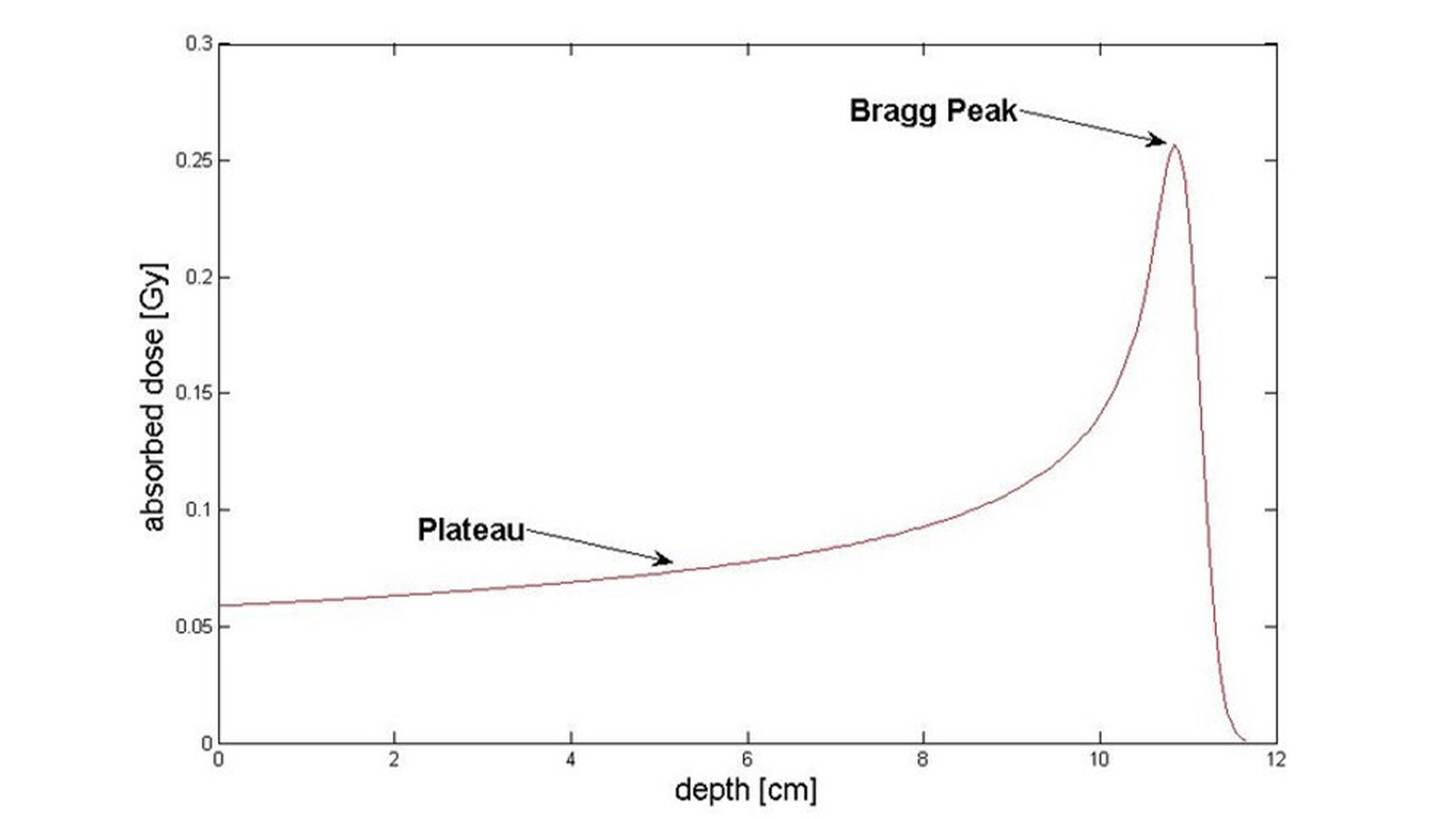
When talking about typical radiation treatment, Schubert expressed that, “It's kind of like an overloading in order to tackle a small area.” However, by utilizing the Bragg Peak, “You're targeting a very specific area of the depth...which means we give a crazy low dose [of radiation].” This is especially important with the types of cancers that Schubert and his team have worked with. “A lot of our stuff relates to work in the brain or other areas where it's highly sensitive,” Schubert continued, “But we are actually very sparing on all the tissue around it [the tumor] because there’s just not a lot of radiation.” By targeting highly specific areas through the aid of proton computed tomography, they are able to minimize collateral damage and increase quality of life for the patient.
Another area in which Dr. Schubert’s research has come into play is with late-stage and fast or aggressive cancers. Schubert explained, “When a tumor starts out, cancer represents itself as normal tissue. So, the body says, ‘great, let me get your resources so it builds more blood vessels.’” Schubert continued, “As it starts growing, it starts growing so fast; it becomes very dense. When it starts getting really dense, it’ll squeeze them [blood vessels], which means you’re not getting resources into the center. You get very low oxygen in particular.” The reason this is important, according to Dr. Schubert, is that regular radiation therapy “becomes only about a third as effective as it is in stages as it would have if there had been oxygen.” However, “with protons and ions, we don’t need that. We don’t need oxygen. We are our own ion. We’re kind of being fired like a cannonball as opposed to a squirt gun.” In Dr. Schubert’s words, “The likelihood of us destroying that cell is much higher. The advantage to this is we remain every bit as lethal, even when it’s an aggressive cancer and late stage.”
The BaylorITS Research Technology team, through the Kodiak High-Performance Computing environment, has been a vital partner in supporting Dr. Schubert’s research. Schubert posited, “How do we do all this stuff? This is all high-performance computing.” The team has utilized the Kodiak environment for all of its high-performance computing needs. “When I first started this, before we put it on a GPU, running on a decent-sized cluster, it could take a day or two,” Schubert continued, “But right now, we can do a decent-sized data set in about 40 seconds with the code we have.” When discussing the partnership with ITS, Schubert stated, “Brian [Sitton] is really awesome for us. He sets up stuff super easy. The ITS group here is very, very supportive.” Schubert went on to add, “When I need something, Brian comes over and helps out. He’s just one call away.”
Dr. Schubert and his team work with, in his words, “A huge amount of stuff...you have to have, basically, a lot of computation power and memory. So that’s where Kodiak comes to our aid. We couldn’t do this without that.” This has allowed for worldwide collaborations with other researchers. “The resources and the tools we’ve built up means a lot of researchers around the world seek out collaborating with us because they need to use our tools.”
The groundbreaking work of Dr. Keith Schubert embodies how Baylor researchers are transforming the world through the power of technology and compassion-driven innovation. By combining high-performance computing with a relentless pursuit of healing, his team is redefining what’s possible in cancer treatment and biomedical imaging. Kodiak’s computational strength enables Dr. Schubert and his collaborators to turn massive data into life-changing insights while accelerating discoveries that bring hope to patients and families around the globe. As Dr. Schubert’s research continues to inspire, it stands as a shining example of how Baylor’s research community uses technology not just to advance science, but to advance humanity. His story reminds us that behind every Computing Catalyst is a partnership between innovation, technology, and a calling to serve others.