

Computing Catalyst: From Dust to Discovery as GPUs Accelerate Breakthroughs in Physics and Astronomy
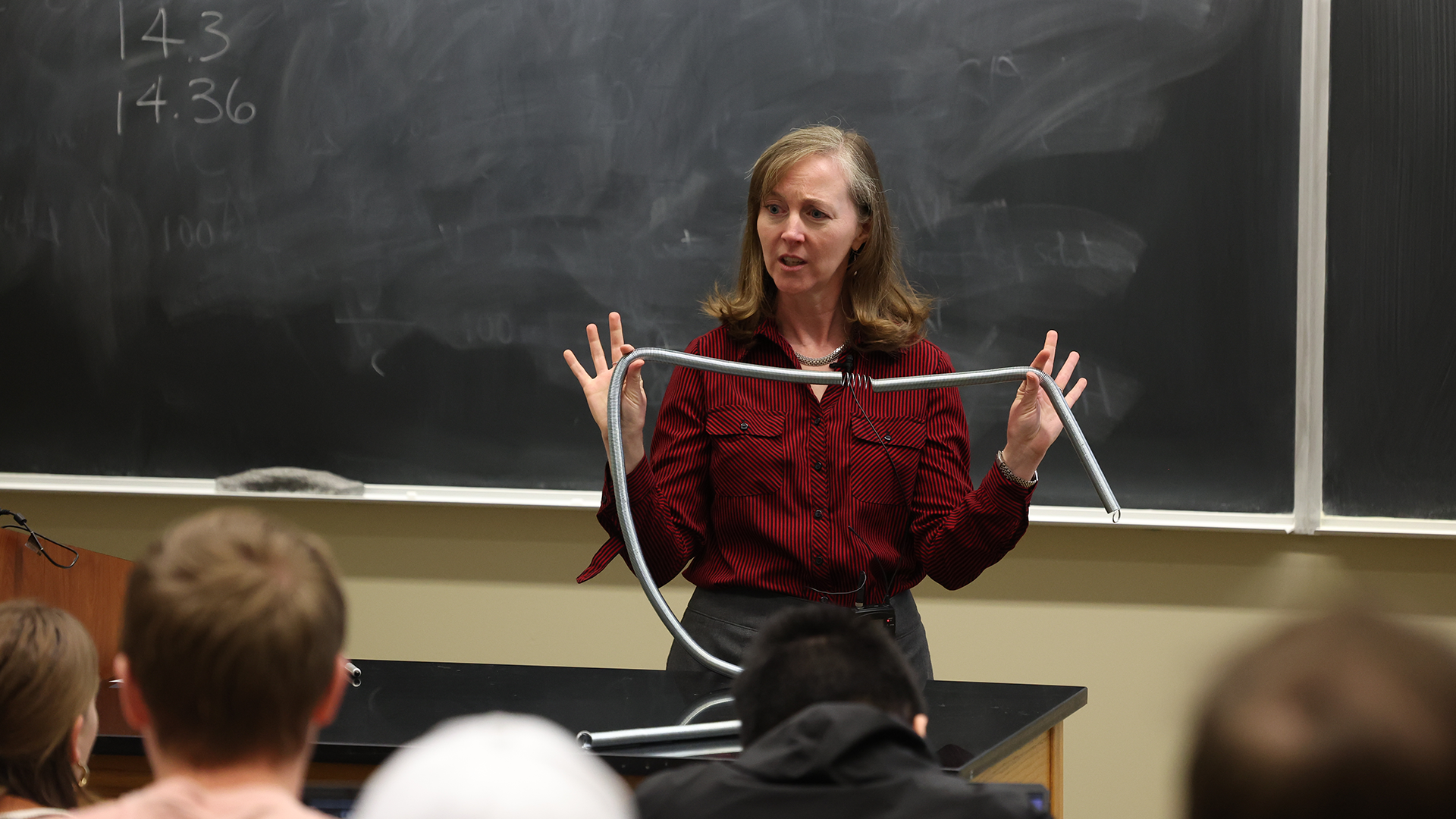
Somewhere in the vacuum of Baylor’s plasma physics lab, a cloud of dust begins to organize itself, forming strings, crystals, and swirling structures that mimic the earliest stages of planet formation. Dr. Lorin Swint Matthews has spent the past 25 years working as a faculty member at Baylor University. During her time at Baylor University, she became one of the earliest adopters of the Baylor University High Performance Computing environment, now known as Kodiak, to bring her pioneering research into reality, placing Baylor at the forefront of research on what is known as “dusty plasma.”
Dusty plasma clumps together in space to form cosmic “dust bunnies” that may eventually form planets. According to Dr. Matthews, theoretical research on planet formation has led to experimental research here at Baylor University. “The Center for Astrophysics, Space Physics, and Engineering Research (CASPER) lab has vacuum chambers where we can ignite plasma within a gas and then drop in dust to see how the dust behaves. The dust charges up, and because the dust grains repel each other while being trapped by a confining force, it will form structures.” Dr. Matthews continued, “So it self-organizes. A lot of what we’re looking at is to determine how it organizes itself. Why do the dust particles want to line up in strings? The answer is that the plasma is doing something you can’t see with the naked eye.” Dr. Matthews and her team have used computer simulations to “see what the plasma is doing to explain the dust structures and dynamics that we see in the experiments.”
The lab further explores research on turbulence and its impact on dusty plasma. “Turbulence is not well understood,” Dr. Matthews explained, “It’s what causes all the eddies in a gas flow. You can’t predict where the gas particles are going: it’s kind of chaotic.” Turbulence is one of the main emphases of Dr. Matthews’ research moving forward, specifically working to track turbulence at what they call “the kinetic level” (the level at which individual particles are moving).
Dr. Matthews’ innovative experience with High Performance Computing (HPC) enabled her research through the power of coding and computer modeling. “I’ve used Kodiak since Kodiak existed,” Dr. Matthews exclaimed, “I (also) used Kodiak’s predecessors, Speedy and Speedy Two.” Her HPC skills have given her great insight into how to best utilize the Kodiak environment. “I run N-body codes, where N refers to the number of particles in the system. I model each individual dust grain and look at the forces acting on it. We can model the way the dust collides and sticks together, and the way that dust aggregates will rotate and align with the direction of plasma flow or magnetic fields,” Dr. Matthews explained.
She continued to explain that she and her team have been able to take advantage of the many compute nodes on Kodiak to “run lots and lots of instances to get lots of data to build up statistics.” Dr. Matthews expounded on the use of GPUs in her research, “With GPUs, we can accelerate our N-body codes very easily without having to use 'message passing interface,' MPI, to speak between all the individual processors. Running a program on one GPU is equivalent to running a program on 1024 processors.” Dr. Matthews’ GPUs within Kodiak have been beneficial when working with modeling ions in plasma. “With the dust, we could get away with modeling, say, 10,000 dust particles, right? On one processor, we could handle that. But for the ions, we need to model 120,000 ions interacting with one dust particle. And so that's an order of magnitude more particles. However, that requires two orders of magnitude (100 times) more computing time. And so, we use GPUs for those calculations.”
Dr. Matthews’ research is empowered by the HPC Condominium Model, which allows researchers to purchase and house their own equipment in Kodiak’s cluster in the Baylor University – Dutton Data Center. Her research lab owns a GPU condominium node within the cluster. This node consists of both a CPU and multiple GPUs. When asked how Kodiak has been able to help enable research that would have been impossible without its aid, Dr. Matthews responded, “When the GPUs got added, that’s when I was able to develop new code that modeled both dust and ions moving on their own time scales. So, that was a code that we wrote just to take advantage of new features of the computing systems.”
By taking advantage of the HPC Cluster Condominium Model provided by Kodiak, Matthews has been able to gain priority access to the computing resources that this node provides, helping to rapidly improve time to research. Utilizing her condo node within Kodiak, she is able to advance the field of physics and astronomy through her research with dusty plasma funded by the National Science Foundation (NSF) and the Department of Energy. Kodiak will also enable new pioneering research possibilities, which includes joining an NSF-funded project that would propel Baylor University to be part of a center that studies turbulence.
These transformative methods of research are part of how Baylor University pursues the Core Commitment to Broadening Interdisciplinary Research and Impact. Through her pioneering spirit, Dr. Matthews demonstrates how curiosity, computational power, and collaboration unite to expand the boundaries of scientific knowledge. Her work shows that when researchers pair world-class expertise with Baylor’s advanced High Performance Computing resources, discoveries once limited to theory become visible, testable, and transformative.